Showing posts with label Australia. Show all posts

2012-09-07

Australia Update: Real Estate Bust Continues — Retail Collapse Begins

Real Estate is imploding, and denial will help the bust to be of historical proportions
(Bloomberg) 2012-08-31 — Melbourne Hasn’t Seen Worst of Housing Drop as Glut Builds
Melbourne, where home prices have fallen more than in any other major Australian city, may see further declines as a record number of new developments approved in the boom years hit the market.
Home values in the capital of Victoria state lost 6.6 percent in the year ended in June, the biggest drop among the eight state capitals, according to researcher RP Data.
Building work started on a record 47,293 homes in Melbourne in the 12 months ended June 2011, compared with estimated demand of 32,334, according to figures from researcher BIS Shrapnel.
You’ve got developers who’re producing a massive surge of supply and they’re all facing losing money unless they sell soon, so there’s huge discounting pressure,” said Steve Keen, author of the book “Debunking Economics” and associate professor in economics at the University of Western Sydney. “And listings are rising because demand has fallen severely.
[...] New construction will keep a lid on any major recovery” in Melbourne, said Louis Christopher, managing director of Sydney-based property advisory firm SQM Research.
[...] Melbourne’s rental vacancy rate was 2.9 percent in July, up from 2.5 percent a year ago, according to SQM. The number of homes listed for sale climbed 4.8 percent from a year earlier to 48,322 as demand slowed, SQM said. Both levels were the highest among Australia’s eight state and territory capitals. Victoria’s moves to do away with tight land-release policies and zoning restrictions had won praise in a nation where such controls are blamed for a housing shortage that’s driving home prices beyond the reach of ordinary workers.
Amazingly, people keep on talking about 'housing shortage' as the cause of the prices skyrocketing.
[...] The median price of a home in Melbourne was $493,688 as of July 31, according to RP Data, based on the exchange rate on that day. That compares with $340,600 in New York, according to real estate data provider Zillow Inc., and $564,593 as of June 30 in London, based on the most recent figures from the Land Registry.
[...] Homes under construction in the city are now 80 percent above the 20-year average, the analysts wrote. Relative to incomes, Melbourne had the fourth-most unaffordable homes among metropolitan areas with populations of more than 1.5 million people in the developed world, consultancy Demographia said in a report in January, behind Hong Kong, Vancouver and Sydney.
[...] Despite the concerns about a glut, “it’s too early to conclude that Victoria’s planning policy failed or created a massive oversupply problem,” Matthew Hassan, Sydney-based senior economist at Westpac Banking Corp. (WBC), said in a telephone interview. “We expect a few moves downward from the Reserve Bank next year, which will bolster a very patchy stabilization process.”
Denial and incompetence illustrated
[...] “We’re in a period in the short-term where we have seen some signs of oversupply,” Brett Draffen, chief executive officer of Mirvac’s development division, said in a telephone interview from Sydney. “But underlying fundamentals will be strong for the medium term and beyond, and that’s when those projects come online.
Exactly the same thing we were hearing in the US in 2006 and 2007. Stupidity Illustrated.

Via Mish:
Retailers want RBA action as sales dive
Retailers hope the biggest monthly drop in consumer spending in nearly two years will trigger alarm bells at the central bank when its board meets to discuss interest rates.

Retail trade fell by a seasonally adjusted 0.8 per cent in July to $21.4 billion, after being bolstered in the previous two months by government handouts and earlier interest rate cuts by the Reserve Bank of Australia (RBA).

Economists had expected an overall spending rise of 0.2 per cent in the data collected by the Australian Bureau of Statistics.

But department stores' sales slumped 10.2 per cent, the largest fall since April 2005.

The Age reports Food, fashion jobs in jeopardy as companies collapse

In another blow to Australia's already shaky retail sector, women's fashion chain Ojay and a ready-to-eat food manufacturer have reportedly been put into administration, threatening hundreds of jobs nationwide.

Food jobs also in jeopardy

It was reported early this afternoon that Australian Convenience Foods Group, which makes sandwiches for petrol stations and supermarkets, had collapsed.

Deloitte has been appointed managers of the company, with up to 400 jobs at risk. The company's history goes back to the 1970s. A receptionist at ACF’s office confirmed the company had collapsed.

Australian Convenience Foods fell into voluntary administration on August 28 and Deloitte is currently running a sale process to sell the business as a going concern to a new owner. Expressions of interest for buyers close tonight.


Australia Employers Unexpectedly Cut Payrolls While At the Same Time Australian Unemployment Unexpectedly Falls

Here's about the magic of government statistics; and over-bullish behaviour of the market; and the mania 'buy buy buy' mentality. And this also illustrates the ways news is reported: the same news can be bullish or bearish; it's just the sentiment of the reporter which will tell you which!

Bloomberg - 2012-09-06 —Australia Employers Unexpectedly Cut Payrolls by 8,800 in August
Australian employers unexpectedly cut payrolls in August for the second month in the past three, as evidence mounts that China’s slowdown is discouraging hiring.
The number of people employed fell by 8,800, the statistics bureau said in Sydney today. That compares with the median estimate for a 5,000 increase in employment in a Bloomberg News survey of 23 economists. The jobless rate declined to 5.1 percent from 5.2 percent as the participation rate dropped to the lowest level in more than five years, a sign that some job seekers exited the labor force.
Bloomberg - 2012-09-06 — Australian Unemployment Unexpectedly Falls, Lifting Currency
Australia’s jobless rate unexpectedly declined in August on signs employers in mining states are still hiring workers, boosting the local currency after a three-day slide.
The unemployment rate fell to 5.1 percent from 5.2 percent in July, the statistics bureau said in Sydney today. The median estimate in a Bloomberg News survey of 23 economists was for a rise to 5.3 percent. The participation rate slumped to the lowest level in more than five years, a sign job seekers exited the labor force. The number of people employed dropped by 8,800, compared with economists’ forecast for an increase of 5,000.

2012-06-18

Peak Over-Confidence and Denial in Australia Confirms Economic Collapse Has Begun

Here are a couple of Bloomberg reports showing just how much Australian policy makers are in denial and plain incompetents (or liars?). From a contrarian perspective, this confirms to me that their bubble-economy has already began its bust is now confirmed. It will soon be time to short their equities and the infamous AUD, THE bubble currency.

Ironically, the public is not a fool, because they feel the pain in their wallets, and hence cannot believe the massaged numbers coming out of the government, nor the lies.

Finally, something I haven't picked up lately, but my forecast from about 2 years ago now, where I predicted rates would go down and not up in complete disagreement with ALL the economists, has been proven wrong.


  • Australia’s Strong Economy Proves ‘Doomsayers’ Wrong, Swan Says
  • Stevens Praises Australian Economy, Warns on Asset Bubbles

(Bloomberg) June 10, 2012 — Australia’s economic performance is proving the “doomsayers” wrong, Treasurer Wayne Swan said ahead of a government conference this week to address challenges including an elevated currency and uneven growth. 
[...] Public support for Gillard’s government isn’t getting a lift from one of the fastest-growing economies in the developed world, led by the resource-rich regions in the north and west. Consumer confidence is subdued and her governing Labor Party trails in opinion polls as tourism, manufacturing and retail industries across the south and east struggle with the sustained strength of the local currency.
“There are always those who are all too ready to talk down our nation’s prospects,” Swan said. “Over the past week, the doomsayers have been proved to be completely and absolutely wrong.” 
[...] Still, consumer confidence in May was near the lowest level this year
[...] Australia’s central bank cut interest rates by 50 basis points late last year and a further 75 points in the past two meetings. At 3.5 percent, the overnight cash rate target is still the highest among major developed economies.

(Bloomberg) June 10, 2012 — Reserve Bank of Australia Governor Glenn Stevens expressed optimism about the nation’s economy and cautioned against monetary policy settings that could reignite asset bubbles, the risk of which he said was low. 
[...] Stevens’s speech, titled “The Glass Half Full,” urged Australians to embrace more subdued spending and borrowing, and steadier asset prices, as a path to sustainable economic expansion and wealth. Employment growth this year and a gross domestic product report showing the economy grew 1.3 percent last quarter, more than twice the level forecast, underscore the nation’s resource-fueled strength.

2012-05-11

Australian billionaire to build Titanic II

As a sign of peak irrational exuberance in the bubble economies of Australia and China, the BBC reports that Clive Palmer, one of Australia's richest men, has commissioned a Chinese state-owned company to build a 21st Century version of the Titanic.

"It will be every bit as luxurious as the original Titanic but of course it will have state-of-the-art 21st Century technology and the latest navigation and safety systems," he said in a statement.

2012-03-03

Australia's Treasurer Starts Class Warfare and Promotes Socialist Lies and Finger Pointing


Amazing story, and amazingly stupid behaviour by the politicians in Australia, biting the hand that feeds the whole bubble economy and starting a social warfare on the people and companies who basically run the country which would be wasteland without mining and agricultural companies.
March 2 (Bloomberg) -- Australian Treasurer Wayne Swan said resource tycoons including Gina Rinehart, Clive Palmer and Andrew Forrest are threatening the nation’s democratic process by using their wealth to shape policy to their interests.
They wouldn't be able to shape anything if:
  1.  Politicians and the state didn't have so much power to being with, as libertarians have been promoting for hundreds of years
  2. Politicians were not so corrupt, and wouldn't accept money, legally or under the table, to change their mind on any topic.
In an article in The Monthly magazine, Swan said the billionaires are undermining the Australian notion of a “fair go” -- where everyone has an opportunity to prosper. He cited a mining companies’ campaign against the resource profit tax in 2010 that contributed to the ouster of former Prime Minister Kevin Rudd.
Oh, now I see it. He wanted to tax them, take by force their property and wealth, and they fought against it. Should they just let the robbers create a low to legally expropriate them?
“The infamous billionaires’ protest against the mining tax would have been laughed out of town in the Australia I grew up in, and yet it received a wide and favorable reception two years ago,” Swan said. “A handful of vested interests that have pocketed a disproportionate share of the nation’s economic success now feel they have a right to shape Australia’s future to satisfy their own self-interest.”
When you fail on the ideological debate, make it personal against the people, and attack them on other grounds. Well done Swan.
The article is a signal of stepped up efforts by Prime Minister Julia Gillard’s administration to build public support for taxes on mining profits and carbon emissions due to take effect on July 1. Her government trails the opposition Liberal- National coalition by 10 percentage points, a margin that if replicated at the election due in the second half of next year would represent a landslide defeat.
 I can only hope that they will fail, and that voters will through these liars and corrupt politicians out. If they don't, well, the future of Australia — already extremely bleak — will be at stake.
“This government, if anything, has been too circumspect in criticizing vested interests,” said Paul Strangio, a senior lecturer on Australian politics at Melbourne’s Monash University, who primarily researches the Labor party. 
“These very wealthy people -- some have described them as oligarchs -- are throwing their weight around in public policy and if they do enter the public arena, and try to impose their influence over public policy, it’s within the government’s ambit to answer that,” Strangio said.
Of course, university professors, socialists and pro-government by definition, always will support attacks against the rich.
BHP Billiton Ltd., Rio Tinto Group and Forrest’s Fortescue Metals Group Ltd. campaigned against the government’s proposed 40 percent tax that helped turn public opinion against Rudd. The former prime minister’s weakening poll ratings were among reasons Labor lawmakers cited for his ousting in a late-night coup in June 2010. Gillard negotiated a lower tax rate to assuage the resource industry.
Seems like politicians will, once they have lost by the rules, try to hit under the belt.
Fortescue said in a statement that its board met earlier today to discuss the “unfounded attacks” by Swan on Forrest. 
The company said it will pay more than A$1 billion in taxes, royalties and other government assessments this year and is projected to pay more than A$2 billion next year. Fortescue described Swan’s comments on its taxes as an “irrational outburst.” 
Forrest “started with nothing and repeatedly put everything he had earned at risk in building one of the most important mining operations in the world,” the company said in response to the treasurer’s comments. “Andrew epitomizes the spirit of what an Australian can do if given a ‘fair go’.”
Who has built something valuable and useful? The "Mining Oligarch"? or the Politician? Who is creating thousands of jobs?
[...]“To be blunt, the rising power of vested interests is undermining our equality and threatening our democracy,” Swan said. “We see this most obviously in the ferocious and highly misleading campaigns waged in recent years against resource taxation reforms and the pricing of carbon pollution.”
How irritating is Swan...
[...] Swan criticized the nation’s four biggest banks last month after Australia & New Zealand Banking Group Ltd. boosted interest rates independent of central bank policy. The Reserve Bank of Australia kept its benchmark unchanged at 4.25 percent at its Feb. 7 policy meeting.
“For reasons that they can explain themselves, from time to time they decide that they want to give priority to their shareholders over their customers,” Swan told reporters Feb. 10. “The fact is that the major banks in this country are very profitable and their interest margins are back to where they were prior to the global financial crisis.”
The fact is that it's none of your business, Swan. Corporations belong to shareholders and ALWAYS give priority to them over their customers. Customers have the right to either go to competition, or decide to pay more.
[...] Rinehart, whose $18 billion fortune tops Forbes Asia’s rich list for women, is set to become the world’s wealthiest woman this year, surpassing Wal-Mart Stores Inc.’s Christy Walton. Forrest has a net worth of $5.3 billion, making him the third- richest Australian, Forbes said. Australia’s BRW magazine estimates Palmer’s wealth at A$5.05 billion ($5.5 billion). 
Australia’s economy is propelled by a mining boom predicted to last decades as the urbanization of hundreds of millions of people in China and India drives demand for iron ore, liquefied natural gas and coal. [...]
I'll cut short here.  Seems like politicians in Australia are as bad as those in France and Greece. God — or, more realistically, Voters — protects and saves the Australians from their destructive and dangerous ideas.

2011-11-01

Australia's Home Price Drop For the Third Consecutive Quarter — Central Bank Drops Rate

The Australian real estate bubble has popped and there is probably no end in sight, but here's the news about the third consecutive quarterly decline.

This is something I forecast more than a year ago, about actually 15 months ago and reiterated many times since then (including here): interest rates have peaked in Australia, and the next move is down.

Well, today, after much anticipation, I was proven right.
Nov. 1 (Bloomberg) -- Australian house prices declined in the three months through September, the third straight quarterly drop, as the developed world’s highest borrowing costs curbed demand. 
An index measuring the weighted average of prices for established houses in eight major cities dropped 1.2 percent last quarter from the previous three months, when it fell a revised 0.5 percent, the Australian Bureau of Statistics said in Sydney today. 
The median estimate of 19 economists surveyed by Bloomberg News was a 1.5 percent fall. They declined 2.2 percent from a year earlier.
Nov. 1 (Bloomberg) -- Australia’s central bank cut interest rates for the first time since 2009 and a Chinese manufacturing index slid, stoking concern that Europe’s debt crisis is weighing on Asia’s export-dependent economies. 
The Reserve Bank of Australia today reduced its key lending rate to 4.5 percent from 4.75 percent, saying Europe’s woes are starting to hit Asian trade. 
In China, a purchasing managers’ index fell to 50.4, the lowest level since February 2009, while South Korea reported the smallest gain in exports in two years. 
Nov. 1 (Bloomberg) -- The Australian dollar fell for a third day against its U.S. counterpart after the Reserve Bank cut interest rates for the first time in 2 1/2 years on signs global growth is moderating. 
The so-called Aussie declined against its 16 major peers after RBA Governor Glenn Stevens said inflation is close to the central bank’s target, adding to prospects policy makers may further reduce rates. 
Demand for the Australian and New Zealand dollars was limited after data showed manufacturing in China, the South Pacific nations’ major trading partner, slowed. “The Aussie is lower after the RBA rate cut,” said Lee Wai Tuck, a currency strategist at Forecast Pte in Singapore. 
It seems like they have opened the door for more rate cuts because they say that inflation is likely to be close to target. I think there’s a possibility there may be another cut in December.”
With China imploding, and the end of the commodities bubble, and the collapse of the real estate bubble, Australia will face the implosion of two enormous bubbles and the only engines of their bubble economy.

From here, I think the probability for the Australian Bubble Economy to fall into the abyss is very high. So high that I wouldn't be surprised to see the AUD/USD trade at 0.50. The probability for this to happen is in my opinion much much higher than to see it at 1.50 as one of my bullish blogger states.

2011-10-21

One of the World's Largest Rare Earth Deposits Found in Australia

Australian web site ABC Rural reports that:
A north Queensland mining company has discovered one of the world's largest deposits of the rare earth, scandium. 
Scandium is used to make solid oxide fuel cells, which are used generating electricity from natural gas and renewable fuels. 
This discovery has been made at a former nickel mine at Greenvale, just out of Townsville. 
With scadnium selling currently selling for $5,000 a kilo, owner Metallica Metals says it will double the size of a planned cobalt and nickel mine at the site. Metallica managing director Andrew Gillies says the deposit's quality and purity are outstanding, and very unusual. 
"Scandium is found probably in most rocks, typically perhaps five to 15 parts per million; we've got sometimes a thousand times that," he said. "We would think that we've got something unique. There's only three resources in the world and we've got two of them."
This is not the first discovery of a massive deposit of Rare Earth metals, so actually, maybe we'll soon change their names (see my previous posts about rare earth minerals). But, it's obviously a great news is you're a consumer of these minerals (and also, end users, such as electronic devices etc.) or for Australia's economy.

On the other end, if you're a speculator with a long position in Rare Earths — an already crowded place, or the Chinese Government Monopoly, you're in trouble over the medium turn.

2011-09-18

More Denial in Australia, One of The Bubble Economies That Just Busted

Here are quotes from a great Bloomberg report about the Great Australian Real Estate Bubble. I don't have much to add really. All the numbers and facts are there, including the final quote from Robertson, who pounds a "This Place Is Different" to explain why Australia is not in a bubble.
(Bloomberg) Sep 12, 2011 — Australia, where home prices are falling at the fastest rate in more than two years, may have a glut of properties and be set for a U.S.-style crash.  
The warning from tax-reform advocate David Collyer, commentator Kris Sayce and academic Steve Keen contrast with banks and developers that say a shortage of about 200,000 homes will underpin prices
The housing bears say builders and lenders are pushing flawed government data to keep prices afloat in the English-speaking world’s costliest place to buy a home. “It’s important for the government and banks to keep the myth of a shortage alive,” said Sayce, editor of Melbourne- based online newsletter Money Morning Australia. “Without it, prices drop, and negative equity results in housing repossessions and insolvent banks.” 
More than two-thirds of the government’s shortage estimate arises by including people who can’t afford housing, such as the homeless or those living in trailer parks, Sayce said. Collyer at tax-reform lobby group Prosper Australia says there’s actually a surplus of more than 250,000 dwellings after 15 years of overbuilding, while Keen argues the shortage estimate is swollen by inflated demand from handouts to property buyers of as much as A$21,000 ($21,700). 
Banks in Australia have more than A$1 trillion of housing loans outstanding, with the four-biggest lenders accounting for about 87 percent of the total. The Australian Bankers’ Association said it doesn’t have a position on the so-called housing shortage myth and declined to comment. 
Australia has the most unaffordable homes in the English- speaking world, Illinois-based consulting company Demographia said in January, with homes costing 6.1 times the average annual income. The median price of apartments and houses in Australia’s eight state capitals has declined 3.4 percent in 2011 -- the most since 2009 -- to A$455,000 in July, according to a report from Brisbane-based researcher RP Data on Aug. 31. The average full-time workers’ annual earnings is about A$70,860. The ratio of household debt to disposable income in Australia is 155 percent, higher than the 133 percent Americans accumulated at the height of the subprime mortgage boom. Demand for housing credit in Australia has plunged to the slowest annual growth pace since central bank records begin in 1977, data Aug. 31 showed. 
[...] The Housing Industry Association, a Canberra-based builders’ group, said on Sept. 1 the nation will have a shortage of about 500,900 homes by 2020 if it continues to build at the pace it has over the past 20 years. The greatest shortages will be in Brisbane, Queensland; Stirling, Western Australia; and the Gold Coast in Queensland, the group said. Recent statistics show that projection is doing little to buoy prices or lower delinquency rates in those areas. Prices in Brisbane fell 6.6 percent in July from a year ago, the biggest decline among Australia’s capital cities, according to RP Data figures. House prices in the Gold Coast dropped 5.4 percent and apartment prices plunged 7.7 percent in the year to March 2011, RP Data said in a July report. Stirling, a suburb 10 kilometers north of Perth’s city center, was among the 100 worst postcodes in Australia with mortgage repayments more than 30 days late as of March 31, according to Fitch Ratings. Across the nation, home loans more than 30 days overdue rose to a record 1.79 percent of residential mortgage-backed securities in the first quarter, while the number of riskier “low-doc” loans more than 30 days late climbed to a record 6.74 percent, Fitch said in May. Bank Research Westpac Banking Corp. (WBC), Australia’s second-biggest lender, in an October report on the nation’s housing market estimated a shortage close to 200,000. Commonwealth Bank of Australia (CBA) and Australia & New Zealand Banking Group Ltd. (ANZ) -- the largest and third-largest banks -- have also published reports in the past year that attribute the run-up in prices over the past decade in part to an undersupply of housing.[...] 
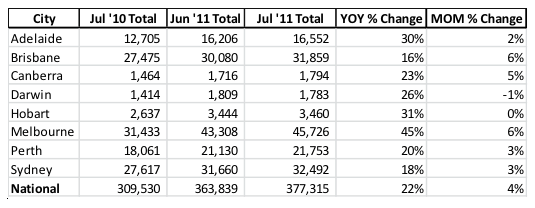
‘The Block’ — one of Australia’s top-rated television shows -- highlighted the housing market’s recent malaise. The series followed four couples as they renovated homes to attract the highest price at auction over set targets. More than 3 million watched the finale on Aug. 21 as just one of the four homes sold, for A$855,000, versus its A$840,000 asking price. Australand, Stockland (SGP) Australia had a total of 377,315 homes listed for sale online in July, a 22 percent jump from a year earlier, according to SQM Research. The percentage of successful sales at auction - - a common sales method in Australia -- in the week ended Aug. 21 was 50 percent, down from 60 percent a year earlier and 78 percent at the same time in 2009, according to RP Data. 
Developers including Australand Property Group (ALZ), Stockland and Meriton Pty, and developer-backed Urban Taskforce Australia, are among groups arguing an undersupply of homes will underpin prices.[...] 
Prosper Australia’s Collyer says there’s actually an excess of 256,324 homes, equivalent to double the housing stock in the nation’s capital, Canberra. That’s because Australia has built one new dwelling for each 2.32 new people for the past 15 years, Collyer said, more than is needed for a nation with an average 2.66 people per home. 
When residential property prices blow into a bubble, the tragic error often made is in attributing price rises to housing shortages,” Melbourne-based Collyer said. “The U.S. experience shows this conviction is shattered as soon as price declines begin.” Prosper Australia’s documentary ‘Real Estate 4 Ransom’ is scheduled to play in cinemas in Sydney, Canberra, Melbourne and Hobart this month and next.[...] 
More than 100,000 properties lie vacant across Australia, 46,220 in metropolitan Melbourne alone, according to Karl Fitzgerald, director of Earthsharing Australia, a subsidiary of Prosper. The group’s estimate is based on the number of homes that used less than 50 liters (13.2 gallons) of water a day between July 1 and Dec. 31. Credit, Supply “When a credit bubble has been created, the only things that keep it growing are more credit and the belief that the commodity is in short supply,” Sayce, who has been warning of a collapse since late 2008, said. 
Credit supply has grown exponentially and is starting to taper off, so all that’s left is the shortage argument.” Sayce expects home prices will fall by as much as 40 percent from their peak in the second quarter of 2010. Money Morning Australia offers commentary on financial news -- paid by advertisers -- to 87,000 subscribers. 
The government’s first-homeowner grant and a resulting spike in mortgage debt have created a false perception of under- supply, according to the University of Western Sydney’s Keen [...] 
As the global credit freeze dented Australian home prices, the government doubled the grant in October 2008 for those purchasing existing homes, and tripled it for buyers of newly constructed housing. Home prices jumped 13.6 percent in 2009. “Households simply can’t and won’t take on more debt relative to income than they already have,” said Keen, an associate professor in economics who is publishing the second edition of his book Debunking Economics in October. “So this avenue for profits for the banks has come to an end.” Keen, who said his Debtwatch blog draws an average of 200,000 hits a day, sold his Sydney apartment in the inner-ring Surrey Hills suburb in 2008, missing out on further gains over 2009 and into 2010. He walked 224 kilometers (139 miles) from Canberra to the top of Mount Kosciuszko in April 2010 after losing a bet made in November 2008 that home prices would drop 40 percent to then Macquarie Group Ltd. economist Rory Robertson.Dr. Keen continues to bang his one-dimensional drum on the Australian housing market, still oblivious to the stark differences between the situation in Australia and what occurred in Japan and the U.S.,” Robertson, who no longer provides housing forecasts in his current role as an economic analyst at Westpac, wrote in an e-mailed response to questions. “Most economists are not so silly as to literally ‘bet the house’ on an economic forecast,” said Robertson, who has owned his own home since 1999.
 And here are quotes from another aspect of the whole Bubble Economy and Denial: the job market and the politicians.
Sept. 12 (Bloomberg) -- Australia’s rise in unemployment last month doesn’t fully reflect the demand for workers in an economy that “continues to outperform” the U.S. and Europe, Treasurer Wayne Swan said. 
“Recent jobs data has underestimated the strength of demand for labor in our economy given an increase in working hours,” Swan said yesterday in his weekly economic note. Australia’s jobless rate jumped to a 10-month high of 5.3 percent in August, the second straight monthly rise, according to a government report Sept. 8. 
Prime Minister Julia Gillard’s administration is trying to counter declines in consumer and business sentiment that last month helped lift the ranks of the jobless to 636,800, the most since October. [...] 
“On top of this, the lingering effects of the global financial crisis and continuing international uncertainty have resulted in Australian consumers being a lot more cautious in their spending,” Swan said. “This is making life harder for sectors like manufacturing, tourism and retailing.” [...] 
Swan also said a tax forum he’s convening next month will focus on ways to keep Australia’s government debt under control. “We’ve seen how important it is to maintain a strong budget position in recent months as the United States and Europe have struggled to get their public finances on a sustainable footing,” he said. “The government will not be in the cart for any measures that compromise our strict fiscal discipline.”
Denial is not going to change anything. The report also mentions

  • that the AUD strength is hurting exports
  • that the borrowing costs are too high.
Expect the RBA to decrease rates to support banks during a collapsing property prices cycles and to help exports. The AUD will take a major hit in consequence of these actions.

Finally, the shift in mood has occurred and things will go downward from here. Here's an example showing the negative mood in action:
Sept. 15 (Bloomberg) — Australia’s central bank, which pays its governor more than Federal Reserve Chairman Ben S. Bernanke and European Central Bank President Jean-Claude Trichet combined, will for the first time lose its sole power to set compensation for its board and executives, Treasurer Wayne Swan said
The salaries at the Reserve Bank of Australia will be fixed within benchmarks that exist in the Remuneration Tribunal, a body that decides how much politicians and civil servants earn, Swan said. The independent authority determines, reports on or provides advice about pay, including allowances and entitlements for federal lawmakers, judicial and non-judicial offices of federal courts and tribunals. 
[...] The move is a culmination of months of debate over central bank salaries, with lawmakers including Bob Katter of northern Queensland state saying RBA Governor Glenn Stevens’s pay increase during the global financial crisis was “outrageous.” Swan wasn’t told until almost a year after the central bank chief got a A$234,000 ($239,000) raise in October 2008.

The RBA chief’s 2010 total compensation was A$1.05 million, with an A$805,000 base salary. Trichet was paid 367,863 euros ($504,900) last year, 2 percent more than his 2009 salary, according to the ECB’s annual accounts published in March. Bernanke earned $199,700.
The savings generated are meaningless and the wasted time (paid for, by salaries) enormous. The fact is that lawmakers are attacking the Central Bankers via their salaries and they show the negative perception of the Central Bank is well entrenched. Having the Central Banks under attack is a good thing!

2011-08-29

Australian Housing Bubble Popped: Still Denial

As usual at the beginning of any secular trend change — in this particular case, the popping of a major real estate and credit bubble which last for about 10 years — people's reaction will always follow these steps:

  1. First is denial — it won't happen here, it's not going to happen here, etc.
  2. Then is rejection — it's not happening, it's a buying opportunity!
  3. Finally acceptance, admission that what is happening is real

So let's see what is happening in Australia, in the wake of their massive real estate bubble which has popped several months ago now: 'Top time to buy' as housing costs fall.
Perth homes are at their most affordable in almost two years on the back of falling prices, stable interest rates and higher wages. 
The Housing Industry Association and Commonwealth Bank measure of affordability improved 3 per cent across Perth and 0.8 per cent nationally in the June quarter. 
The required loan repayment for a median-priced house in Perth is $3325 a month. 
A year ago it was $3558. Housing affordability in Perth improved 15.6 per cent in the past year and is now better than in late 2009. 
Elsewhere in WA, affordability rose 2.5 per cent in the quarter to be 12.6 per cent better than a year go. 
HIA senior economist Andrew Harvey said it had been almost five years since homes across Australia were as affordable as they were today
"Improved affordability is good news for homebuyers," he said. "If we look through the global financial crisis period, which was skewed by unprecedented cuts to interest rates, we have not seen affordability reach its current level since 2006. 
"With new home building moderating and some easing in pressure on skilled trades, now is a particularly good time to consider building a new home." 
Median house prices peaked at about $505,000 early last year and have eased to $470,000. At the same time, wages continued to climb and interest rates were last increased in November. 
Together they make getting into the Perth housing market the easiest in almost 21 months. Affordability will improve even more if a survey for mortgage broker Loan Market proves accurate. 
Of those surveyed, 56 per cent said the 4.75 per cent cash rate should be lowered, with just 16 per cent arguing it should be increased. 
Twenty-two per cent believe the Reserve Bank should cut rates twice by the end of the year.  
Bank governor Glenn Stevens will face a parliamentary committee today where he is expected to be pressed on the future movement of interest rates.
We are still at the first stage: denial.
One thing that's interesting is that 22% now believe that the RBA will now be cutting rates, something I forecast long ago, when 100% were thinking rate increases were the only thing in the stash.

2011-08-10

Unsold Housing Supply Soars In Australia — The Collapse Marches On

An interesting report about the state of the housing market in Australia was released today (courtesy of MacroBusiness) — Housing supply and unsold inventories are skyrocketing showing that the collapse in price will follow soon:

Stock on Market for the Month of July 2011
Embargoed until 12.01am Wednesday 10th August 2011
Figures released this week by property research house SQM Research revealed that residential property listings for the month of July 2011 rose by 13,476 to 377,315 nationally. This is a 4% increase from June 2011, as well as a 22% increase when compared to the same month (July 2010).
All capital cities except for Darwin and Hobart experienced a month-on-month increase, Brisbane and Melbourne experiencing the highest surge in stock- both increasing by 6%.

This means that the banking system in Australia will soon collapse, that their central bank will have to cut the interest rates drastically, and that the AUD will collapse.

How big the collapse? Probably bigger than what we saw in 2008. And it was already quite bad back then: from 0.95 to 0.65 in a matter of 2-3 months.


2011-08-09

The Great Australian Dream Is Just a Facade

The Great Australian Dream Is Just a Facade — this is a quote from the Sixty Minute Australia report on the real estate collapse in Australia. The 13 min report is very sad. Lives are destroyed. Countries collapse. All this due to the greed that has taken over the entire population and the credit bubble that has been propelled by easy money and credit...

Unfortunately, the law of cause and consequence is ineluctable.

Below are a few quotes from a Bloomberg report released today:
(Bloomberg) Aug 8, 2011 — Australian home-loan approvals unexpectedly stagnated in June as buyers sought fewer properties for investment.

[...] That compares with the median estimate for approvals to rise 0.8 percent in a Bloomberg News survey of 18 economists.
[...]
The total value of loans fell 1.4 percent to A$20.2 billion ($20.3 billion) in June, today’s report showed.

The value of lending to owner-occupiers was unchanged, the report showed. The value of loans to investors who plan to rent or resell homes dropped 4.4 percent.

First-home buyers accounted for 15.2 percent of dwellings that were financed in June, down from 15.4 percent in May and lower than 16.2 percent a year earlier, the report showed today.

Australia’s labor market lost 5,400 jobs in the April-June period, the weakest quarter since 2001. Sales of newly built dwellings fell 8.7 percent in June, the biggest decline in five years, a private report showed Aug. 1.

A day later, a government report showed house prices fell 1 percent in Perth and dropped 1.6 percent in Darwin from the previous quarter, while they advanced 0.4 percent in Sydney and gained 1.1 percent in Canberra. In Melbourne, prices slipped 0.1 percent.

2011-07-21

Real Estate Is Different In Australia — It's not Going to Happen There — Unfortunately It's Never Different This Time

While the Australian real estate bubble seems to have popped, people are still in the first phase of the collapse, that is, denial. See Mish's post: Permanently High Plateau Theory Touted for Australia Housing.

In addition to the Australian being in denial, foreigners are, like the moth attracted to the candle's flame, attracted the high yield Australian RMDS, which obviously will make things far worse. The extent of the euphoria is yet again reaching historical records, as shown by the sentence highlighted below: Australian RMDS as a discrete asset class separate from the others.

Moreover, you can see the destructive and dangerous policies of central banks in action as well: Japanese investors are buying Samurai RMBS because the yield in Japan have been sitting at around 0% for so long.

Additionally, it looks like the market has finally realised that rates must be reduced in Australia — something I forecast almost a year ago, while 100% of the pundits were sure of the opposite:
I'm about as sure as anybody can be that rates have topped in Australia and that the next move is going to be down. They are following the US steps with a 3 year lag. It's almost a certainty that the RAB will cut rates almost to zero to save their banks, and in doing so, will create a massive collapse of the AUD.
Although there has been a 0.25% rate increase since last July, I think my forecast was still pretty good. 
July 20 (Bloomberg) -- Mortgage bond sales in Australia are accelerating from the busiest half since 2007 as investors snap up higher-yielding notes while Europe’s sovereign crisis causes the market for other corporate debt to slam shut.
[...]
Australian RMBS may be viewed as a discrete asset class that’s separate from the volatility” caused by rising sovereign risk in Europe, said David Goodman, Sydney-based Westpac Banking Corp.’s director of asset-backed securities. “It’s performed very well, so people are clearly buying.”
[...]
Bendigo and Adelaide Bank, the Australian regional lender, priced A$1 billion of notes on July 14, including 20 billion yen of securities, the first time an Australian issuer has sold mortgage bonds in the Japanese currency, according to Moody’s Investors Service. It paid 425 basis points more than the bank bill swap rate on the lowest-ranking portion of notes and a spread of 105 basis points on the main class, according to a stock exchange filing.
[...]
Sales of prime securities peaked at A$57 billion in 2006 before tumbling to A$13.4 billion in 2008, Standard Poor’s data show. The first six months of 2011 was the busiest half since 2007, according to Westpac.

The Australian government has bought A$13.6 billion of the debt since 2008 as part of a support package to help smaller lenders obtain funding, according to information on a government website. [...] 
Australian mortgage holders grappling with the highest benchmark interest rate in the developed world may get some respite as traders bet the central bank will cut the official cash rate of 4.75 percent.

There is an 84 percent chance RBA Governor Glenn Stevens will cut the benchmark rate a quarter percentage point in October, cash-rate futures showed at 5:22 p.m. in Sydney yesterday.

The central bank, which has kept the rate unchanged since November 2010, had scope to extend the pause because risks posed by Europe’s debt crisis and a slower-than-forecast domestic recovery eased inflation concerns, minutes of its July 5 meeting published yesterday show.

Australia’s economy shrank 1.2 percent in the first quarter, the biggest contraction in two decades, after flooding in Queensland state slashed export earnings. The RBA signaled this month that growth this year may be weaker than its earlier forecast of 4.25 percent.
[...]
“We’re starting to see a bigger divergence in Australian collateral performance between regional or smaller lenders and the major banks,” said Nick Bishop, a portfolio manager in Sydney at Aberdeen Asset Management Plc. “Overall though, it’s a deteriorating but still sound picture.”
The truth is, outside of the mining industry, Australia's economy is sinking, and when the Chinese bubble pops, the mining sector is also going to fall like a rock. By the way, did you know that 50% of the Australian economy was the household spending? Isn't that amazingly counterproductive and dangerous at the same time? I was told mining and agriculture were driving the economy in Australia?
July 18 (Bloomberg) -- A drop in Australian consumer demand that sparked the biggest weekly slump in retail stocks in more than two years is spilling into the nation’s credit markets.
[...]
Australian household spending, which represents about half the nation’s economy, has stalled amid natural disasters, falling home prices and increased savings. [...] 
“The weakness in the Australian retail sector has taken a further leg down, and we expect an increasing number of retailers will be requiring rent assistance or being forced to close their stores and default on leases,” said Ben Byrne, a Sydney-based credit analyst at Nomura Australia Ltd. “While this will have a greater impact on equity, it will also cause a general underperformance of the sector in credit.”
As I stated above and about a year ago, I do no think there will be any more interest rate rise in Australia, and that the next move is down. Expect to see the AUD fall like the GBP did in 2007-2008. Similar pattern, probably even more dramatic.

Congratulations to Westpac economists, which after lagging for a whole year behind me, are the first among the nation's lender to predict a rate cut.
July 15 (Bloomberg) -- Australia’s central bank may push back its next interest rate rise by three months as languishing consumer spending gives it time to assess Europe’s debt crisis and whether a mining investment boom will stoke inflation.

The Reserve Bank of Australia will raise the official cash rate a quarter of a percentage point to 5 percent in November, according to the median estimate of 21 economists surveyed by Bloomberg News this week. A survey three weeks ago showed the median estimate was for a rate increase in August. Economists at Westpac Banking Corp. went further, becoming the first among the nation’s four biggest lenders to predict a rate cut in December.

In an economy Treasurer Wayne Swan last week maintained is “the envy of the developed world,” Australian households are closing their wallets as the developed world’s highest interest rates, rising energy bills, falling home prices and global concerns sap confidence. With spending accounting for about half the nation’s economy, consumer caution is restraining growth even as the mining industry increases investment.

“The consumer is wary,” said Warren Hogan, chief economist at Australia and New Zealand Banking Group Ltd. “They’re being told that there’s this economic boom either happening or coming for Australia, but they’re not seeing it.”
[...]
Westpac, with A$279 billion ($297 billion) in home loans outstanding, today said in a statement that “interest rates are too high in Australia given the state of the non-mining sectors of the domestic economy.” The Sydney-based bank predicted the nation’s unemployment rate may rise as high as 5.75 percent next year from 4.9 percent last month, sending the local currency and bond yields lower.
[...]
This week’s “awful reports from the big retailers” are among the latest evidence that consumers are still struggling, said Helen Kevans, an economist at JPMorgan Chase which this week changed its forecast for the next RBA rate increase to November from August.

2011-07-05

Australian Real Estate Bubble Popping — Marc Faber urged investors to short ANZ

The Australian property bubble might have finally popped, and when the drop accelerates, you can expect the same scenario as what happened in the UK in 2007-2008: a massive change in the monetary policy, with interest rates dropping to zero, and a collapse of the AUD, of epic proportions.

If you add to that a collapse in equity and commodities markets, the fall can easily reach 40% against the USD.

Here are a few quotes from the Bloomberg report:
Australian home prices slid 1.7 percent in the first quarter from three months earlier, the biggest drop since the third quarter of 2008, government data in May showed. Prices fell 0.3 percent in both April and May, according to RP Data.

Demand for mortgages, which account for about 63 percent of banks’ outstanding loans in Australia, slowed in April to the weakest annual growth rate since data began in 1977. Home loans more than 30 days late hit a record 1.79 percent in the first quarter, Fitch Ratings said on May 26, and “low-doc” loans that were more than 30 days overdue climbed to 6.74 percent.

Marc Faber, publisher of the Gloom, Boom & Doom report, last month urged investors to short-sell Australia & New Zealand Banking Group Ltd. (ANZ) shares, citing excessive household leverage and an overvalued property market. Faber, who made the call in Barron’s Mid-Year Roundtable, didn’t respond to e-mails seeking comment for this story.

Mike “Mish” Shedlock, an investment adviser at Sitka Pacific Capital Management, who publishes the Global Economic Analysis blog, says such shortage claims are “pure nonsense.”

2011-04-12

Harry S. Dent interviewed on Daily Ticker

Harry S. Dent was interviewed on the 31st of March on TechTicker. His forecast is basically the same as about a month ago:
  • Expect "substantial" further gains for stocks before a "major top" occurs in late summer 
  • Dent predicts the Dow will trade as high as 13,200 by mid-summer and the S&P 500 as high as 1430, or more-than 7% above current levels. "then we could see another major crash," forecasting the Dow at 3,300 in a worst-case scenario.
  • The Fed is checkmated.
  • Shanghai and Hong-Kong are the biggest real-estate bubbles in the world.
  • We have a worldwide real-estate and credit-bubble, we'll have a worldwide crash.
  • Sydney is the biggest bubble in the western world.
Here are the two parts of the interview:
  1. Harry Dent: “Major Crash” Coming for Stocks, Commodities Already Topping Out
  2. “Housing Is Dead”: Bubble Still Bursting Here and Abroad, Says Harry Dent


2011-03-11

Asia-Pacific Property Investment Rose 45% in the second half of 2011

When it comes to financial markets, the speculators prefer to put their money were prices are rising. This is the very opposite of any other market. For example, when you go shopping, you prefer to buy more when items are on special offers or on sales. But when speculating, the opposite is true: higher prices attract more investment.

Here, assets are ballooning, and targeting Australia and China, the two biggest real estate bubbles probably bigger than the UK...

This will end in tears.
March 10 (Bloomberg) -- The money earmarked for property investments in the Asia-Pacific region rose 45 percent in the second half [of the year] as China’s expanding economy made them more attractive, according to estimates compiled by DTZ Group Plc.

Real-estate funds and companies had about $104 billion available for investments in the region, up from $71 billion a year earlier, the London-based property broker said in a report today. Local funds and companies accounted for 92 percent of the total, according to DTZ’s “Great Wall of Money” study.

China and Australia remain the most popular target countries in the region,” said David Green-Morgan, head of research for the Asia-Pacific countries.

The region accounted for almost 32 percent of the $329 billion set aside for real-estate acquisitions at the end of 2010, up from 24 percent a year earlier, DTZ’s study showed.

China attracted the most real-estate investment in the world for a second straight year in 2010, New York-based Real Capital Analytics Inc. said in January. Most of the $197 billion spent in the country was used to buy development sites, the property-research firm said.
[...]
Money earmarked for property investment worldwide climbed 17 percent in the six-month period. Investments were spread equally between the Americas, Asia-Pacific and Europe regions. That’s a change from 2008, when about half the money was invested in Europe.

Europe registered a 2 percent increase in money targeting real estate to $114 billion, while in the Americas there was a 14 percent gain to $111 billion, DTZ estimates.

2011-03-10

China Unexpectedly Posts $7.3, Billion Australian Employers Unexpectedly Cut Worker, New Zealand Unexpectedly Cuts Rate by 0.5% — 100% of all economists surveyed on these points were wrong

China Unexpectedly Posts $7.3 Billion, the Biggest in Seven Years, Australian Employers Unexpectedly Cut Worker, New Zealand Unexpectedly Cuts Rate by 0.5%. All this during a single day. Have these far east bubble economies finally topped?

A few interesting points about China:
  • All 21 economists were expecting a surplus and were hence completely wrong. As expected.
  • Chinese entrepreneurs must be squeezed between commodity prices soaring at one end, and salary increases forced on the employers by their governments.
  • Western economies want China to boost internal consumers, which is what this trade deficit could mean, but at the same time, markets seem to be unhappy with the trade deficit announced today. 
Interesting points about Australia:
  • All 20 economists were expecting the number of jobs to rise and were hence completely wrong. As expected.
  • Employers unexpectedly cut workers. Why unexpectedly? Because for the past couple of months, all the lemmings were celebrating the floods that would bring in a lot of construction spending (Broken Window fallacy) and that they would also result in a lot of hiring for cleaning the mess and reconstruction. Doesn't seem like it's happening, on the contrary. Now they are telling us that "floods and cyclone disrupted hiring".
  • It looks like the next move from the Central Bank will be to cut interest rates, and not raise them, as I have been forecasting, against the consensus.
Of course, all these could be one-offs. But for the good of the economy and the people, it's important that the credit bubble busts (and of course that the central banks are abolished, along with fiat currency and partial reserve banking).

Here are some quotes from the Bloomberg reports, starting with China:
March 10 (Bloomberg) -- China reported an unexpected $7.3 billion trade deficit, the biggest in seven years, buttressing the government’s case against U.S. arguments for faster gains in the yuan.

Exports rose 2.4 percent in February from a year before, the least since 2009 as Lunar New Year holidays disrupted shipments, and imports climbed 19.4 percent, customs bureau data showed today. Central bank adviser Li Daokui said that the full-year trade surplus will shrink from the 2010 level.
[...]
Today’s number compared with a $6.5 billion surplus in January. The median estimate in a Bloomberg News survey of 21 economists was for a $4.9 billion excess of exports over imports in February.
[...]
Speaking in Beijing, Li, the central bank adviser, said the annual surplus may slide to $150 billion this year, from $183 billion in 2010 and the record $295 billion in 2008. Chinese officials this week affirmed policies to boost domestic consumption, including raising minimum wages an average of 13 percent a year in the five-year plan running through 2015.

The swing in February to a trade deficit may aid central bank officials working to prevent an excess of cash in the financial system from worsening inflation that has already breached the government’s 4 percent target for 2011. Pressure for more increases in banks’ reserve requirements may ease, Bank of America-Merrill Lynch said in a note.
[...]
The nation last posted a trade deficit, of $7.2 billion, in March 2010.
Australia:
March 10 (Bloomberg) -- Australian employers unexpectedly cut workers in February for the first time in 18 months as floods and a cyclone disrupted hiring in the nation’s northeast.

The number of people employed fell by 10,100 from January, led by a drop in part-time jobs, the statistics bureau said in Sydney today. That compares with the median forecast for a 20,000 increase in a Bloomberg News survey of 20 economists. The jobless rate held at 5 percent.

Reserve Bank of Australia Governor Glenn Stevens said last month a deluge in January and cyclone in February in Queensland may cut 1 percentage point from growth this quarter. Recent reports showed building approvals declined by the most in eight years, consumer confidence slid and retail sales are slower, suggesting the central bank may have scope to extend a pause in interest-rate increases.
[...]
The number of full-time jobs advanced by 47,600 in February and part-time employment fell by 57,700, today’s report showed. Australia’s participation rate, which measures the labor force as a percentage of the population over 15 years old, dropped to 65.7 percent in February from 65.8 percent a month earlier, it showed.
New Zealand:
March 10 (Bloomberg) -- New Zealand’s central bank cut its benchmark interest rate to a record low, reducing the attractiveness of the nation’s assets as officials from Beijing to London move to contain inflation by raising borrowing costs.

Governor Alan Bollard today lowered the official cash rate half a percentage point to 2.5 percent and signaled no change until next year, citing the economic damage of an earthquake in Christchurch. Ten of 14 economists surveyed by Bloomberg News expect rates are on hold until the first quarter next year.

New Zealand’s dollar, the worst-performing G-10 currency this year, may fall further on concern the nation will slide into a recession and the prospect that Australia, Korea, the euro area and the U.K. will raise rates this year. Bollard said the economy may contract in the first quarter as the aftermath of the magnitude 6.3 quake in the nation’s second-largest city on Feb. 22 hurts consumer confidence and spending.
[...]
Eighteen of 25 economists surveyed by Bloomberg News expect Australia will raise its benchmark rate in the second quarter.

2010-12-23

The IMF says Australia’s house prices may be overvalued by 5 to 10 percent

Those geniuses at the IMF came up with a great report: house prices in Australia might be overpriced by 5 to 10%. Un-be-lievable.

House prices in Australia are probably somewhere close to 50 to 60 percent overvalued in AUD terms; and close to 80% in USD terms (considering the AUD is 20% overvalued against the USD).

As for the US already 4 years ago now, inventory is rising substantially (23% for LJ Hooker, 40% for luxury homes).

No expert believes prices will decline, and yet, sellers are willing to cute prices by 15%, and properties are listed or auctioned, but no buyers.

If this wouldn't qualify as keeping the head in the sand...

Let's dive into the Bloomberg report:
Dec. 22 (Bloomberg) -- Australian luxury home prices may fall in 2011 after listings of properties worth more than A$1 million rose about 40 percent more than average for this time of year, according to the Real Estate Institute of Australia.
[...]
Australia’s house prices may be overvalued by 5 percent to 10 percent, the International Monetary Fund said last week. An 11 percent advance in the Australian dollar this year, the second biggest among Group of 10 nations, is deterring foreign and expatriate buyers, while the most aggressive tightening of monetary policy in the developed world raised borrowing costs.

Prices of the most expensive 10 percent of Sydney properties dropped 7.5 percent in the six months to September, compared with an average 1.1 percent increase in the rest of the market, according to real estate researcher RP Data. Melbourne’s top end property prices fell 10.8 percent in the period, compared with an average 2.5 percent price climb for the remaining homes.
[...]
An auction of homes ranging from A$2 million to A$10 million last month, held at the Sydney Opera House by real estate broker Ray White Group, sold only two of the 11 homes on offer.

“The luxury market is certainly softer than what it was,” Dan White, a director at Brisbane-based Ray White, said in an interview. “There’s a lot of speculation about house prices, comments that they’re overvalued. And that happened at the same time that rates started to increase. Buyers are now feeling that they can search for value.”
[...]
There will be a recovery of between 5 percent and 10 percent in the top end of the market next year, primarily in the second half, as economic confidence returns, said McGrath.
[...]
More properties are selling before auction, “a sign of vendor nervousness,” Curtis said, with some sellers willing to cut prices by as much as 15 percent.
[...]
LJ Hooker, which has 695 offices across the Asia-Pacific region, had about 23 percent more listings in November compared with a year earlier, according to data from the company.
[...]
“I don’t think things will decline further, but I don’t think they’ll suddenly get better,” Jacobs said. “The market will become more firm, but the change will be gradual.”

2010-11-14

Australian Unemployment Rate Unexpectedly Jumps

Those who have been following my posts about Australia and the AUD know that I believe that the AUD has been peaking and that the Australian bubble is also about to pop.
Nov. 11 (Bloomberg) -- Australia’s unemployment rate unexpectedly jumped in October to a six-month high as the pool of workers and job seekers swelled to a record, easing concern that a labor shortage will drive up wages.
Surprise surprise !!

The jobless rate rose to 5.4 percent last month from 5.1 percent in September, the statistics bureau said in Sydney today. That exceeded the median forecast of 5 percent in a Bloomberg News survey of 24 economists. The participation rate, which measures the workforce as a percentage of the population over 15 years old, climbed to 65.9 percent from 65.6 percent.
Not surprised that the participation rate is increasing: people need to pay for the properties they bought at bubble prices...
[...]
The hiring surge threatens to boost inflation, which the central bank aims to keep in a range of 2 percent to 3 percent. The consumer price index in the third quarter rose 2.8 percent from a year earlier, a government report showed last month. 
[...]
Stevens said last week that “growth in wages has picked up somewhat” and “some further increase is likely over the coming year.” As a result, he said in a statement after the Nov. 2 rate increase, “the moderation in inflation that has been under way for the past two years is probably now close to ending.”
Lower unemployment is not really inflationary when credit and money is unlimited... On the other hand if there's such a great boom in Australia, it would be normal that wages increase to reflect that gain in wealth, etc. right? Again silly economics...
The RBA, in a quarterly report on Nov. 5, reiterated its forecast that economic growth will strengthen to 3.75 percent by the end of 2011, climbing to 4 percent by the end of 2012. Consumer prices will rise 2.75 percent through June 2012; previously, the RBA had estimated inflation of 3.25 percent through mid-2011.

Australia’s growth is propelled by surging shipments of iron ore and coal to China that are boosting jobs in regions such as Western Australia, even as household demand elsewhere is cooling after seven interest-rate increases since October 2009.
Another major surprise! Who could have known.
[...]
Home-building approvals and retail sales were weaker than economists forecast in September, and house-price gains decelerated in the third quarter, reports published last week showed. Consumer confidence declined in November to a five-month low, according to a survey released yesterday.
Maybe it's finally popping?

2010-11-03

Australia Raises Interest Rate to 4.75%

To my surprise – my forecast was wrong - Australia's central bank did raise their interest rates to 4.75%. While 0.25% is not much, let's hope that will do the job when it comes to pricking the real estate bubble there. Let's remember that 4.75 is the rate that Bernanke achieved before the big collapse of both US rates, and the economy in 2007 (already 3 years!).
Nov. 2 (Bloomberg) -- The Reserve Bank of Australia unexpectedly increased its benchmark interest rate on concern stronger growth will cause inflation to accelerate, driving the nation’s currency toward parity with the U.S. dollar.

Governor Glenn Stevens raised the overnight cash rate target a quarter point to 4.75 percent in Sydney, saying the economy has “relatively modest amounts of spare capacity” and citing risk of “inflation rising again over the medium term.” It was the RBA’s first move in six months.
Central planners are at it again...
[...]“They’re trying to nip inflation in the bud,” Matthew Circosta, an economist at Moody’s Analytics in Sydney, said on Bloomberg Television. “Back in 2007 they were behind the curve” in raising rates and “I don’t think they want to make the same mistake this time around.”
As usual, the same entity which creates inflation is pretending to fight it.