Showing posts with label CAD. Show all posts

2010-12-14

Debunking bubble economies - Canada pt6

Here's some food for thought for those who are still wondering what is the source of the Canadian "miracle":
Dec. 14 (Bloomberg) -- Canada’s top economic officials yesterday urged households to be wary of taking on too much debt after data showed the indebtedness of Canadians surpassed U.S. levels for the first time in 12 years.

Bank of Canada Governor Mark Carney, Finance Minister Jim Flaherty and Prime Minister Stephen Harper said in separate public appearances that they are concerned about rising debt. The ratio of household debt to disposable income in Canada was 1.48 in the third quarter according to Statistics Canada, exceeding the U.S. level of 1.47.[...] 
In Canada, where banks largely escaped the global financial crisis and continued to lend even as credit dried up elsewhere, low interest rates have encouraged consumers to take on debt.

[...] Measures to restrain lending taken earlier this year included changes for government-backed mortgages that forced buyers to meet standards for five-year, fixed-rate mortgages even if they opt for variable rates. Limits on refinancing were made stricter and down payment rules were tightened.

The proportion of Canadians in a stretched financial position “has grown significantly,” Carney said in his speech -- entitled “Living with Low for Long” -- adding that authorities continue to monitor households’ finances.

“The level of vulnerabilities of households remains high” Carney said at the press conference. “The authorities are cooperating closely, we are continuing to monitor the situation closely.”

To be sure, Harper said his government cannot “exaggerate” the degree with which it can control borrowing. [...]
To spook Central Bankers and government officials so much, the data must be particularly awful. I don't think Canada will dare raising interest rates, given that so many people are already stretched. This means that the most probable sequence of event will be:

  1. Massive increase in personal bankruptcies and mortgage defaults
  2. Lower interest rates to rock bottom (ZIRP)
  3. Massive borrowing by the gov to cover for the guarantees it made on the mortgages
  4. Sharp fall of the CAD and potentially drop of the sovereign debt.
  5. Deflation followed by rise of sovereign debt (this is difficult to forecast, as I don't know the Canadian Central bank enough, but that's currently my bet anyway).

2010-09-26

Euro update

We've been following the Euro against the CAD, AUD, and USD since May 2010, where I started opening my positions.

A few weeks ago, I got driven out of the EUR/AUD position, making some sizable loss because I was sizably wrong, even though originally that position was highly profitable... Asta la vista.

On Friday, before the close, I reduced my long EUR position against the CAD and the USD, having a gut feeling that both the rise of the Euro was to fast to be sustainable, that the fall of the USD was also too dramatic given the deflation that's happening there, and that all in all, sentiment on equity has reached the exuberance required for a top.

Here are the relevant charts.


I was looking forward finding some interesting research over the week-end, and Babak over at Trader's Narrative happens to have the perfect data I needed

The charts below confirm my intuition that it's about time to get long USD again. I'm still very bearish on the AUD and the CAD, but it's time to use the USD and close down the EUR positions.

I wouldn't be surprised that the start of a correction in gold and equity markets will coincide with the bottom of the US, due any time soon now.


Short retrospective here, with the highlight points here:
  • 2010-08-09 — I decided to stay long the Euro because John Taylor was forecasting a top, and I was forecasting he was wrong: Could John R. Taylor, Jr be more wrong? - take 2
  • 2010-07-16 — I decided to stay long the Euro while Mish was forecasting a top. Tough call to go against Mish. I'm glad I was independent enough to make it: Euro update
  • 2010-06-13 — I decided to jump on the long EUR after careful analysis done the previous weeks, and the fear that Bob Prechter was showing about the Euro. If even Prechter is scared and 'wouldn't touch it' it means you absolutely have to do it. Robert Prechter on BloombergTV's Closing Bell

Debunking bubble economies - Canada pt3

Canada has the world safest banks. It's somehow true — amazingly.
Sept. 9 (Bloomberg) -- Canada’s banking system was ranked the world’s soundest for the third straight year by the World Economic Forum.

The study, released today by the Geneva-based organization, places Canada’s banks ahead of New Zealand, Australia, Lebanon and Chile in its executive opinion survey.

Canadian lenders including Royal Bank of Canada and Toronto-Dominion Bank withstood the financial crisis without taking government bailouts, and recorded only a fraction of the $1.3 trillion in writedowns taken by banks and brokers worldwide.

“It’s good to be number one,” Canadian Finance Minister Jim Flaherty told reporters today in Kitchener, Ontario. “It has made a big difference in terms of Canada’s reputation in the world, and our leadership in the world in the G8 and the G20, particularly with respect to fiscal matters.”

Canada slipped one notch in the forum’s Global Competitiveness Index to 10th place. The report noted that “improving the sophistication and innovative potential of the private sector,” would help to increase competitiveness.
Why? Because banks do not take the risk on any mortgage they provide: the government does. It's like if all the mortgages in the US were underwritten by Fannie and Freddie. We know what happened to Fannie and Freddie, so we know what will happen to the Canadian sovereign debt and currency: default and collapse.

Look how foolish their Finance Minister is. "It's good to be number one". Well of course, it's good for the banks to have all their debt 100% guaranteed by the government. But then, it cannot possibly be any good to the state or the citizens. The bubble is going to burst sooner rather than later, and both Canadian sovereign debt and canadian sovereign currency will take a major major, very likely historical, hit.

Debunking bubble economies - Canada pt2

So much for the export and natural resource driven economy and all the other rationalization nonsensical explanations you find for Canada's real estate bubble and the strength of its economy:
Sept. 9 (Bloomberg) -- Canada’s trade deficit unexpectedly widened to a record in July as exports to the U.S. fell, government figures showed, adding to evidence the country’s economic recovery is being crimped by its southern neighbor.

The deficit widened to C$2.74 billion ($2.66 billion) in July, the biggest gap since the agency’s records began in 1971, from a revised C$1.81 billion gap in June, Statistics Canada said today in Ottawa. Economists surveyed by Bloomberg predicted the deficit would narrow to C$800 million from an initially reported June gap of C$1.13 billion, according to the median of 15 estimates.

The figures suggest international trade this year may be more of a drag on the economy than initially forecast. The Bank of Canada predicted in July trade will shave 1.6 percentage points from Canada’s growth this year. Yesterday, the central bank raised its benchmark interest rate for a third time this year to 1 percent, saying it expects households and businesses to spend even as the outlook for the U.S. economy weakens.

“It’s obviously a disappointment,” said Mark Chandler, head of Canadian fixed-income and currency strategy at Royal Bank of Canada in Toronto, the nation’s largest lender. “It’s starting to become a bit of a concern. We need improving terms of trade and improving commodity price and stronger U.S. domestic demand to start to turn this thing around.

Trade cut 3 percentage points from the annual rate of growth in the second quarter, and the continued weakness may lead the central bank to cut its forecast for economic expansion in October from the current 3.5 percent, Chandler also said.

Canada’s trade surplus with the U.S., its largest trade partner, narrowed to C$1.17 billion in July from a revised C$2.4 billion the prior month.

“We are concerned about some weakness in exports,” Finance Minister Jim Flaherty told reporters today in Kitchener, Ontario. “The good news is, and I can say this because the data is starting to show increased investments in Canada in machinery and processing equipment, business investment is starting to come back in Canada.”

Imports of machinery and equipment rose 1.3 percent to C$9.81 billion in July and have gained 6 percent since the same month a year ago.

The Canadian dollar traded at 1.0346 per U.S. dollar at 2:18 p.m. in Toronto, 0.3 percent stronger than late yesterday. One Canadian dollar buys 96.67 U.S. cents.

Exports to all countries dropped 0.7 percent in July to C$32.8 billion. Exports of forestry products were down 5.3 percent and machinery and equipment sales fell 1.9 percent. Exports of energy products dropped 0.8 percent, while shipments of “other consumer goods” fell 7.3 percent. The volume of exports slid 0.6 percent, while prices fell 0.2 percent.

Imports rose in July, gaining 2 percent on purchases of energy products, which advanced 12 percent. Automotive imports to Canada gained 2.9 percent, the statistics agency said. Prices for imported goods rose 0.6 percent, while volumes of Canadian purchases of goods abroad advanced 1.4 percent from June, the agency said.

2010-08-19

Debunking bubble economies - Canada pt1

This should not be the first in a series about the Canada's bubble economy, but I didn't get the time during the past few weeks to post about the housing system there.

In one sentence, here's how Canada's socialist-style housing trust work: It's like a fully 100% guaranteed by government Fannie and Freddie. Scary? It doesn't look like so the IMF, and many other self-proclaimed financial or economist experts/advisers.

Very worth noting: Usually, foreigners are the late comers to any market and along with the retail investors, they are the ones who buy at the top and get screwed. The obvious reason is the complete lack of understanding of what they are doing.

In this report, while the Canadians are backing off these toxic assets — probably because they don't have the funding anymore, not because they know it's toxic — foreign suckers are rushing in.

Aug. 19 (Bloomberg) -- Foreigners bought a record share of Canada Housing Trust’s C$2.25 billion ($2.2 billion) bond sale, ratifying a report this week that showed international investors can’t get enough Canadian debt.

International buyers purchased 37 percent of the 3.35 percent bonds due in December 2020, according to Andrew Hainsworth, the director of debt capital markets at Bank of Montreal’s BMO Capital unit, lead coordinator of yesterday’s sale. That’s the highest ratio since Canada Housing Trust began selling 10-year bonds in November 2008.

“The international side, the outside-Canada placement, was very robust,” Hainsworth said in a phone interview from Toronto. “Canada is obviously attractive.”

Canada Housing, the financing arm of the nation’s housing agency, sold C$3.55 billion of mortgage bonds in all, including the 10-year fixed bonds and another C$1.3 billion of five-year, floating-rate debt. The 10-year bonds sold at a spread of 46 basis points over yields on benchmark government securities.

Foreign investors bought a net C$6.96 billion of Canadian bonds in June, the 18th straight month they purchased more bonds than they sold, Statistics Canada reported Aug. 17. That’s the longest since at least 1988. The last time foreigners sold more of the nation’s bonds than they bought was in December 2008.

“In just a year and a half, foreign investors have accumulated a stunning C$170 billion of Canadian portfolio securities,” Warren Lovely, a government debt strategist in Toronto at Canadian Imperial Bank of Commerce, wrote in a note yesterday. “Foreign investors have found much to like, be it stronger economic growth, a generally appreciating currency, political stability, a superior fiscal standing or unparalleled banking sector strength.”

Investors outside Canada bought C$135 billion of the nation’s bonds since 2009, four times more than the combined purchases of its stocks and money-market paper, Lovely wrote.
[...]
Canada’s annual inflation rate accelerated in July, with the consumer price index rising 1.9 percent from a year earlier, compared with 1 percent in June, according to the median estimate of 19 economists surveyed by Bloomberg News before Statistics Canada reports the data on Aug. 20.

Demand for the Canada Housing debt was helped by the fact that the bonds are “zero-risk weighted, government of Canada- backed” and that Canadian debt has lagged behind U.S. Treasuries recently, making “the relative entry point” for some international investors more attractive, BMO Capital’s Hainsworth said. Yields on 10-year Canadian government bonds have dropped 23 basis points since June, compared with a decline of 30 basis points on Treasuries.
[...]

2010-07-16

Euro update

Here's what has become the accidental Euro update. Today was another very strong day for the Euro, which hit multi-month high against not only the bubble dollars (AUD and CAD) but also against the USD — even though it hit hard against the 1.30 resistance and failed to sustain the break out due to the big fall in the equity markets. Generally speaking, the whole week has been a pretty amazing one for the Euro, as you can see on the three charts below:


The previous week saw also a big reduction in terms of the speculative short positions against the Euro in the futures market, which confirms my forecasts from the past several weeks (chart courtesy of ZeroHedge).


I kind of guess that the massive rally in the euro has now brought this short covering rally to an end and that the positions should be about flat.

What will happen from here? I think the rally in the EUR/USD should have some more legs, even though we are getting probably closer to end. My target was about 1.35-1.40, I hope I'm going to be right, specially since Mish just posted a few minutes ago and is expecting a dollar bounce. I think it's a bit premature, at least against the Euro. Against the CAD and the AUD, the USD bounce has probably already started.

I'm expecting the EUR/USD to top when the speculative positions in the futures markets will hit 20000 — hopefully 40000, but that's a bit of a stretch.

Bubble Canada to buy 65 Lockheed Martin F-35

Today, Lockheed Martin announced that:
FORT WORTH, Texas, July 16th, 2010 -- The Government of Canada today announced plans to acquire the Lockheed Martin F-35 Lightning II as the country’s next-generation fighter aircraft. The F-35 will replace Canada’s fleet of CF-18 Hornets that entered service in the early 1980s.
[...]
The F-35 is a supersonic, multi-role, 5th generation stealth fighter developed and funded by a consortium of nine countries, including Canada. It is designed to excel in both air-to-air and air-to-ground operations and features the most comprehensive and powerful avionics of any fighter ever produced. Canada plans to acquire 65 F-35s to replace the CF-18 fleet that is currently in service. Delivery of Canada’s F-35s will begin in 2016.
According to Wikipedia, each of these F-35 costs about US$200,000,000. So basically, Canada is wasting about $13 billion on these aircrafts. Why? Is there any rational reason for such a waste? What are they going to do with it? Probably nothing, but at least some guys pocketed probably a nice sum of money under the table, in an offshore account...

2010-07-15

Getting ready to short the Bubble Economies: Canada and Australia

I've been documenting myself about Canada and Australia, which are two of the most resilient and biggest bubble economies at the present time. While I have gathered lots of material, I haven't had a chance to post about them yet, except mentioning that I have shorted the CAD and the AUD as part of my long EUR position.

I was a bit surprised this morning when I ran into the following Bloomberg report:
July 14 (Bloomberg) -- John Malone, the billionaire chairman of Liberty Media Corp., said he’s invested a portion of his family’s fortune in the currencies of Australia, Canada and Norway amid concern that the long-term value of the U.S. dollar may decline.

Malone, 69, whose net worth was valued at $2.4 billion by Forbes in March, said he’s more comfortable with the monetary and fiscal discipline of those countries compared with the U.S., in an interview in Denver broadcast today with Bloomberg Television’s “In the Loop with Betty Liu.”

Malone said he’s become more conservative in protecting his assets. [...] Malone said he’s avoiding investing in gold. “I’m not a gold bug. There’s just something about gold that seems artificial to me,” he said.

“The vast bulk of my wealth is still in U.S. equities and companies that I’ve founded or I am still a major investor in,” Malone said. “I feel good about the companies. I’m worried about the macro environment.”

Liberty, based in Englewood, Colorado, has controlling interests in the Starz Entertainment cable networks, global cable systems and the QVC shopping channel.
Why surprised? Well, it seems completely obvious that John Malone, apart from being a very good business man as proved by his track record, is totally ignorant when it comes to money, economics and financial markets. His statements about the AUD, CAD and gold as well as his holding onto US equities make it very clear.

I'm sorry for Mr Malone because he's going to get crushed speculating on the forex markets, while believing that he's conservative and is protecting his assets. I'm even more sorry for him because he's going to be the perfect contrarian indicator for me, leading to me increase my shorts in both the AUD and CAD (something I started early morning today) as had become Jeremy Grantham, in one of the most ridiculous market calls he ever made.

Let's see results for today the two currencies felt hard against the Euro, as you can see on the two following charts:


I will try to come up with posts about Australia and Canada. But if you were thinking about investing in those countries, you have been warned. Caveat Emptor.

2010-07-01

I ♥♥ €

This is a follow up from yesterday's post. I am very much impressed by the massive rally that we had in the Euro today. It completely took me by surprise, as I never sought such a massive rise was in the decks, specially while the equity markets were falling sharply. I think the Euro has more to gain, but given who quickly it rose, I'm not sure whether it will make a pause first or not... Still holding tight at the moment.

I ♥♥ €

On the 29th, I wanted to increase my AUD short, but thought 1.44 in just one day was too much, and that a drop would follow... instead, it moved to almost 1.46 the next day, and to about 1.49 the following day! 

2010-06-30

I ♥ €

Even with the equity markets inability to sustain any kind of rebound — as I forecast just a few days ago yet again — the Euro is now rebounding nicely today especially against bubble economies currencies like Canada or Australia — another lucky forecast! Let's hope we keep on this track.

I ♥ €
I ♥ €
I ♥ €


2010-06-29

Quick market & euro update

Last Sunday, I published a post stating that we had an extremely good shorting opportunity, and that NOW was the time to short. Call it luck, but the fact is that the markets dropped nicely, as they have been for the past 6 or so sessions.

Today, we broke all short term supports, and it's not only the lowest close for the year, but also the lowest close since September 2009. The markets have already traced back 10 months and we are about where we were about a whole year ago.


Hard to forecast from here. I would like to see another relief rally so that I can sell into it (the previous was too short lived for me to be able to increase my positions in a sizeable way unfortunately), specially since we are in a short term oversold position, but one cannot exclude another drop from this oversold position as there aren't really any shorts to cover, the bears having been slaughtered by 15 months of continuous rallying and the bulls never ever doubting the new bull market are already fully invested, if not invested on margins...

Today saw a major rally in the USD — which is something I didn't think would happen, specially in this magnitude against the Euro:

But the Euro managed to stabilise where the markets kept on dropping. I'll keep a bullish standpoint, although I am thinking I might have been after all. But the reason why I remain bullish on the Euro, is that it managed to make sizeable gains against other currencies, like the CAD and AUD, which I have also shorted against the EUR. So all hope is not lost for the Euro yet, and for my Euro trade:


2010-06-24

Confirmation of the Euro trend reversal?

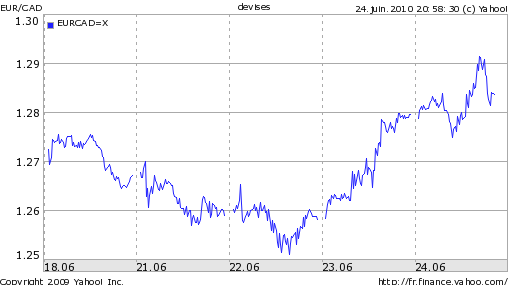
It seems like the Euro has finally bottomed a few days ago, and today might be just the confirmation I was hoping to get: it's the first time that the markets drop quite nicely, but the EUR rises against most currencies, including the USD. It might mean that short covering is starting.


Although I'm in the money with my short USD, the timing wasn't perfect - but I was lucky enough to have entered a short CAD position at about the rock bottom levels a couple of weeks ago, and enter a small short AUD position yesterday. Now, the difficult part, riding the trend as much as possible without missing the reversal, starts.

2010-05-20

The EUR rebound continues

While market pundits shout "intervention" because they missed the rally and are losing money being short the Euro, the European Currency continued the massive rebound it started yesterday, as forecasted yesterday. This most probably due to short covering, and not any kind of central bank intervention.

The Euro took almost 6% against the canadian dollar in just 2 days. Very impressive.

2010-05-19

The EUR rebounds

As expected (just check the last few days posts), the Euro nicely rallied today. I believe it's the beginning of the short covering, which should create a self-sustaining rally on the short term (the more the Euro will rally, the more the shorts are going to cover).

Once the rally is deemed sustainable, the trend follower and momentum driven type of speculators will join, and lead the currency higher.

Then, the masses are going to see in this rally the demise of the dollar and we'll have yet another bounce.

Once the magazine covers start displaying the death of the dollar, you know it's time to sell your Euros again and revert back to the USD.

I've taken the opportunity given by the market during the last several days to build up my long EUR short CAD and USD positions to a reasonable size, though I would have preferred to grow it a bit more. The question is: shall I grow it after such a massive rally?

2010-05-13

Getting Long the Euro

I've mentioned the intention to go short the CAD over the past several weeks, and also my intention to go long the Euro during the past couple of weeks.

I opened two small long positions in the Euro today: against the USD at 1.265xx and against the CAD at 1.290xx. These are position I hope to get the opportunity to grow: on my short Euro trade, closed last Friday, I got so lucky on the timing that I never got in a position where I could add to my trade comfortably, unfortunately.

The Euro is at a historical low against the CAD and at a strong resistance level against the USD. Let's see what the future brings us.

Here are two long term charts:

2010-04-28

Canadian style Credit Bubble in charts

David Rosenberg, over tha Gluskin Sheff, shared quite some interesting data about the canadian credit bubble (and the real estate bubble that goes with it) today (free subscription required to access the file).

Here are some charts: